
Vermiculture and vermicomposting are eco-friendly and sustainable methods of converting organic waste into high-quality compost using earthworms. This natural recycling process not only enriches the soil but also plays a vital role in organic farming, waste management, and eco-agriculture. With the rising awareness about soil health, chemical-free produce, and sustainable farming, starting a vermicomposting business is both environmentally impactful and economically viable.
This business idea requires minimal investment, uses readily available organic waste, and can be started even on a small plot of land, making it ideal for rural entrepreneurs, farmers, and agro-startups.
Visit this Page for More Information: Start a Business in Vermiculture and Vermicompost Industry
Contents
- 1 What is Vermiculture and Vermicomposting?
- 1.1 1. Types of Earthworms Used in Vermicomposting
- 1.2 2. Setting Up a Vermiculture and Vermicomposting Unit
- 1.3 3. Machinery and Tools Required
- 1.4 4. Licenses and Certifications
- 1.5 5. Market Demand and Buyers
- 1.6 6. Cost and Investment Breakdown
- 1.7 7. Profit Margin and ROI
- 1.8 8. Marketing and Sales Strategy
- 1.9 Final Thoughts
What is Vermiculture and Vermicomposting?
Vermiculture refers to the cultivation of earthworms, particularly for the purpose of producing compost and as a source of live feed for fish and poultry.
Vermicomposting is the process of breaking down organic waste (like kitchen scraps, farm residue, cow dung, etc.) using specific species of earthworms (e.g., Eisenia fetida) to produce nutrient-rich organic compost known as vermicast.
This compost is rich in:
-
Nitrogen
-
Phosphorus
-
Potassium
-
Microbial life
And it’s widely used in organic farming, nurseries, landscaping, and kitchen gardens.
Read our Books Here: Biofertilizer, Biofertiliser, Biogas, Organic Farming, Vermicompost, Vermiculture, Biotechnology
1. Types of Earthworms Used in Vermicomposting
Not all earthworms are suited for composting. The following species are commonly used:
-
Eisenia fetida (Red wigglers)
-
Eudrilus eugeniae (African nightcrawler)
-
Perionyx excavatus (Indian blue worm)
These species thrive in decaying organic material and reproduce rapidly, making them ideal for commercial vermicomposting.
2. Setting Up a Vermiculture and Vermicomposting Unit
The setup is simple and low-cost. Here’s how you can start:
a. Land and Space Requirements
-
Minimum: 500–1000 sq. ft.
-
Ideal: Shaded, well-drained area
-
No direct sunlight or rain exposure
b. Vermicompost Bed/Structure
You can use:
-
Brick-lined beds (3 ft × 10 ft × 1 ft)
-
Cement tanks or plastic bins
-
Raised beds under thatched roofing
c. Materials Needed
-
Cow dung (pre-decomposed)
-
Agricultural waste
-
Vegetable peels, dry leaves, husk
-
Moisture (40–50%)
-
Earthworms (1 kg can process 1 quintal of waste)
d. Step-by-Step Process
-
Pre-decompose farm waste with cow dung for 10–15 days.
-
Fill the vermicompost bed with this mixture.
-
Introduce earthworms evenly (approx. 1 kg per 100 kg of waste).
-
Cover the bed with a jute sack or gunny bags.
-
Sprinkle water regularly to maintain 40–50% moisture.
-
Compost will be ready in 45–60 days.
-
Separate worms by light exposure and harvest the black granular compost.
3. Machinery and Tools Required
While most of the process is manual, you may need:
-
Shovels and rakes
-
Sieving machine (for compost refinement)
-
Moisture meter
-
Vermiwash collection unit (for liquid extract)
-
Compost packing machine (optional for scale)
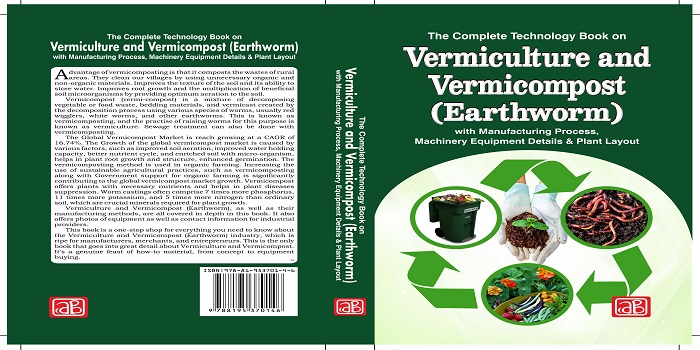
Download PDF: The Complete Technology Book on Vermiculture and Vermicompost (Earthworm)
4. Licenses and Certifications
Though vermicomposting is a low-regulation business, for commercial selling, you may require:
-
Udyam (MSME) Registration
-
Fertilizer license under the Fertilizer Control Order (FCO)
-
GST registration
-
Organic certification (for exports or branded products)
You can also opt for Agmark or ICAR-certified compost testing to boost credibility.
5. Market Demand and Buyers
Vermicompost is widely used by:
-
Organic farmers and horticulturists
-
Fruit and vegetable growers
-
Landscaping and gardening companies
-
Nurseries and plantations
-
Government schemes like MIDH and organic farming missions
-
Agro-based startups and retailers
Packaging Options:
-
1 kg, 5 kg, 10 kg, and 25 kg bags
-
Bulk packs for farms
-
Branded packs for retail stores and eCommerce
6. Cost and Investment Breakdown
A small-scale vermiculture and vermicomposting unit can be started with minimal capital.
For 1000 sq. ft. unit:
| Item | Cost |
|---|---|
| Shed and vermibeds | ?30,000 – ?50,000 |
| Earthworms (20–30 kg) | ?10,000 – ?15,000 |
| Tools and trays | ?10,000 |
| Labor and water setup | ?15,000 |
| Branding, Packaging & Misc. | ?10,000 |
| Total Initial Cost | ?75,000 – ?1,00,000 |
7. Profit Margin and ROI
The vermicompost business is highly profitable, especially with repeat buyers and bulk orders.
-
1 kg of vermicompost sells for ?8–?15 (retail) and ?4–?7 (bulk)
-
From 1000 kg of organic waste, you get approx. 600–700 kg of vermicompost
-
Monthly production from a 1000 sq. ft. unit: 2–3 tons
-
Monthly gross income: ?30,000 – ?50,000
-
Net Profit Margin: 40–60%
-
Break-even: Within 6–8 months
Additionally, vermiwash (liquid extract) can be bottled and sold as organic pesticide/fertilizer, adding a new revenue stream.
8. Marketing and Sales Strategy
To grow your vermiculture and vermicomposting business:
-
List on Agri B2B platforms (AgriBegri, BigHaat, IndiaMART)
-
Partner with organic stores and farmer cooperatives
-
Create a brand name and eco-friendly packaging
-
Sell on Amazon, Flipkart, Jiomart (gardening section)
-
Use WhatsApp, Facebook, and Instagram for farmer reach
-
Educate buyers on benefits through workshops and farm tours
-
Collaborate with NGOs promoting sustainable farming
Final Thoughts
Starting a vermiculture and vermicomposting business is more than just a venture—it’s a contribution to a sustainable, organic future. It helps in managing biodegradable waste efficiently while creating a high-demand product with minimal environmental impact.
With growing interest in chemical-free farming and green entrepreneurship, vermicomposting offers both profitability and purpose. Whether you’re a farmer, agri-preneur, or eco-conscious businessperson, this is your chance to turn waste into wealth and soil into gold—literally.
Related Feasibility Study Reports: Biotechnology
See More Links:
- Start a Business in Asia
- Start a Business in Potential Countries for Doing Business
- Best Industry for Doing Business
- Business Ideas with Low, Medium & High Investment
- Looking for Most Demandable Business Ideas for Startups
- Startup Consulting Services
- Start a Business in Africa
- Start a Business in India
- Start a Business in Middle East
- Related Videos
- Related Books
- Related Projects
- Related Market Research Reports
NIIR PROJECT CONSULTANCY SERVICES, DELHI
An ISO 9001:2015 Company
ENTREPRENEUR INDIA
106-E, Kamla Nagar, Opp. Mall ST,
New Delhi-110007, India.
Email: npcs.ei@gmail.com
Tel: +91-11-23843955, 23845654, 23845886
Mobile: +91-9097075054, 8800733955
Website: https://www.entrepreneurindia.co
https://www.niir.org