
How to Set Up a High-Tenacity Industrial Webbing and Seatbelt Fabric Manufacturing Plant in India
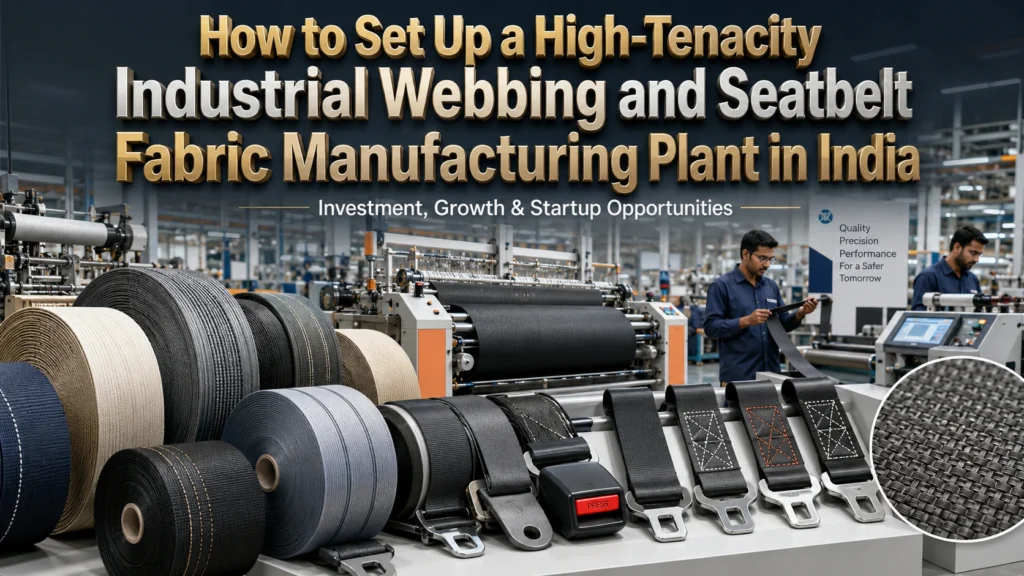
High-Tenacity Industrial Webbing Manufacturing Plant On Indian roads more than 15 crore vehicles use seatbelts manufactured from high-tenacity webbing each year. Then there are the thousands of tonnes in industrial lifting slings, para drop gear for the Indian Army, container lashing belts and adventure sports harnesses – and that’s a market that most people walk past day in and day out without even recognising it. India imports about 35-40% of its high-performance technical textile webbing requirements, mostly from China, Taiwan and South Korea. The cost of imports is in the hundreds of crore rupees every year. That the India deficit is not because of a failure of policy is not a claim to be taken for granted. It is a call that is open to you. One of the most unglamorous but most-profitable segments in the Indian technical textile industry is the high-tenacity industrial webbing and seatbelt fabric. No consumer brand name to build and no retail distribution headaches. You’re selling to automotive OEMs, defense procurement firms, cargo logistics firms, and safety equipment manufacturers, all of whom sign annual purchase agreements and pay promptly, and who demand quality above all else. So, if you are thinking of starting a manufacturing business with a defensible customer base, low advertising costs and domestic demand that is growing with the growth of the auto sector and Indian infrastructure then this is the article you should read. Get Detailed Insights from This Book: The Complete Technology Book on Textile India’s Import Dependency: A Supply Gap Worth Hundreds of Crore The data released by the Ministry of Textiles puts the value of India’s technical textiles industry at INR 2.19 lakh crore, and this is projected to grow to INR 4 lakh crore in the near future. In this, one of the most im-port-dependent segments is the industrial webbing and belting. The use of seat belts in the passenger vehicle sector alone exceeds 8,000 tonnes of webbing annually. As per reports from Society of Indian Automobile Manufacturers (SIAM), homegrown passenger vehicle production has hit the 40 lakh mark per year, which is on the back of consistent demand, with the requirement of fitting seatbelts on all seating positions under AIS-072 norms. There are also commercial vehicles, two-wheelers with lap belts and bus retrofitting which contribute to the volume. Another under-served pocket is defence procurement. High tenacity webbing is required by Indian Army, Air Force and Para Military for load-bearing equipment, para-descent equipment, vehicle towing strap and rifle sling. The DRDO has been alerting on dependency on imports in the field of technical textiles on several occasions. Domestic manufacturers that are certified by BIS and have the military grade testing clearance enjoy a captive market where there is hardly any room for price negotiation. The current capacity of webbing production in India is largely in Karnataka, Tamil Nadu and Gujarat, but these produce less than 65% of the national demand. States such as Rajasthan, Uttar Pradesh and Maharashtra have a high proportion of downstream consumption (automotive, construction, agriculture) with little or no upstream webbing manufacturing. That is the opening. Industrial clusters with highest demand concentration and those requiring urgent supply of locally-sourced webbing are mapped against state-wise demand concentration in the table below. Table 1: State-wise Industrial Webbing Demand and Key Clusters State / Region Key Application Major Industrial Cluster Estimated Annual Demand (MT) Maharashtra Automotive seatbelts, cargo straps Pune, Nashik, Aurangabad 18,000–22,000 MT Tamil Nadu Auto ancillary, defence webbing Chennai, Coimbatore, Hosur 14,000–17,000 MT Gujarat Industrial lifting, marine Surat, Ahmedabad, Vadodara 12,000–15,000 MT Haryana / Delhi NCR Seatbelts, safety harness Faridabad, Gurugram, Manesar 10,000–13,000 MT Rajasthan Military, para-drop webbing Jaipur, Jodhpur 6,000–8,000 MT Uttar Pradesh Cargo securing, agriculture Kanpur, Agra, Noida 5,500–7,000 MT Source: SIAM Annual Report, Ministry of Textiles Technical Textiles Mission, DRDO procurement data. MT = Metric Tonnes. Why Entry Now Makes Commercial Sense The launch of the National Technical Textiles Mission (NTTM) has come with a budget of INR 1,480 crore which is the biggest structural push India has given in this sector. Industrial webbing, geotextiles and safety belts are specific categories mentioned in the mission. The Production Linked Incentive (PLI) scheme offers 15% incentive on incremental sales for technical textiles in the first two years, followed by 11% and 3% respectively in the subsequent years. There are three macro factors that are all driving demand up. First: India’s vehicle production is on the rise steadily. At a minimum, 4–7 metres of seatbelt webbing is needed for every new vehicle. The market for seatbelt webbing is expanding with the introduction of new seatbelt in certain commercial categories under the new crashworthiness rules and as EV makers such as Tata, Mahindra and Ola Electric increase their production. Secondly, the BIS mandatory certification order for personal protective equipment now extends to industrial safety harnesses, climbing slings and fall arrest systems – all of which are based on high-tenacity webbing as the principle structuring material. This compulsory certification system effectively bans imports that are not certified and provides the domestic manufacturers with a quality threshold for the imported products. Third: India’s exports of readymade garments, cargo and industrial goods all go through container shipping. The lashing straps used in containers and cargo securing webbing, which are fully composed of high-tenacity polyester or nylon, are being used in huge numbers at all the major ports—JNPT, Mundra, Chennai and Vizag. PMEGP (Prime Minister’s Employment Generation Programme): This provides capital subsidy of up to 35% for new manufacturing units in rural areas. The credit guarantee provided by CGTMSE is up to INR 5 crore, which is collateral-free and is offered to the initial borrowers of the MSME. Subvention on machinery loans is given under TUFS (Technology Upgradation Fund Scheme) at 4-6%. All the above are unlocked after a 10-minute Udyam Registration in the MSME Ministry. Get Detailed Project Report (DPR): Technical Textiles: Agrotech to Sportech Projects How to Set Up: A Step-by-Step Blueprint Investment and Space The total investment required in the small-scale entry (8-10 high speed
China Earns ₹150–400 Cr/Year Selling LLINs to India — Why Not Your Factory?
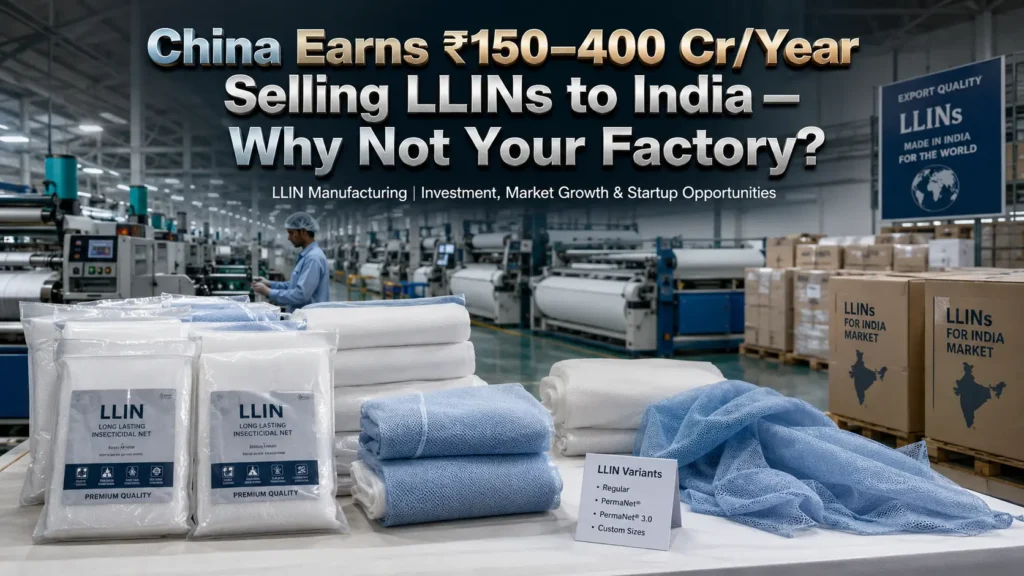
LLIN Manufacturing Plant in India Malaria is by no means solved in India. The country has an unusually high burden of malaria in the South-East Asia Region of the WHO and vector control is the least expensive of the public health arsenal. Mosquito nets that are treated to kill or repel mosquitoes for up to three to five years are known as Long Lasting Insecticidal Nets (LLINs) and they are recommended by the WHO. For a long period of time, India has relied on imports for supplying institutional demand of the Ministry of Health and Family Welfare, state health departments, defence forces, and para-military forces. Now that that dependency is about to split open a realistic domestic manufacturing opportunity. The introduction of HIL (India) Limited in the LLIN manufacturing, where they have developed one product named as HILNET at their Rasayani plant in Maharashtra, is a positive sign for private participation in this sector. The initial capacity already in place is 10 million nets a year. Now, the Indian entrepreneurs have only one question to answer: will they be moving before the import window is closed? Why This Sector Is a Strong Startup Opportunity Demand signal is clear and institutionalized. The Ministry of Health and Family Welfare (MoHFW) is the buyer of LLINs under the National Vector Borne Disease Control Programme (NVDCP), and the demand for LLINs has been estimated to be at the rate of tens of millions of nets per year. There is also a contribution from the Central Armed Police Forces (CAPFs), defence establishments and NGO distribution chains. Historically all this procurement has been done through imports from countries such as Thailand, China, Sri Lanka etc which make India vulnerable to price volatility and supply disruptions. This has left the government with a proactive drive to develop locally manufactured options. In the Annual Report 2025-26 of Ministry of Chemicals and Fertilizers, Government of India, Limited developed and commercialized LLINs with a motive to minimize dependence on imports and contribute to the Atmanirbhar Bharat programme. The report further states that the following agencies are being supplied: Ministry of Health and Family Welfare, state health departments, defence forces, CAPFs, PSUs and NGOs — which means that any private LLIN manufacturing company in India would be their direct target. Investment-wise, this is a sector that has proven institutional buyers, provable import substitution rationale and policy support. It is unusual to find that combination. For the majority of manufacturing startups, it’s an imperative that they build demand. LLIN entrepreneurs can enter into an already established, funded demand curve. However, there are real entry barriers that are not prohibitive. An Indian LLIN manufacturing plant which includes the polyethylene monofilament extrusion line, net-weaving machine, insecticide treatment line, and quality testing facilities generally requires an investment of Rs. in the project. 8 crores to Rs. The cost, depending on size and automation, is 25 crores. The licensing requirements are that it must be registered with the Central Insecticide Board and Registration Committee (CIB&RC) and meet the WHO standards (PES 60 denier standard). High density polyethylene (HDPE) granules, LLDPE granules and alpha-cypermethrin / deltamethrin active ingredients are all available domestically as raw materials. The government scheme support is available via PMEGP (small units up to Rs. 20 lakh project cost under manufacturing, CGTMSE collateral free facilities for MSMEs and potential PLI benefits to LLIN nets in specialty textile and technical textile categories. Related Article: India vs China Manufacturing: Best Business Opportunities, High Profit Sectors & Startup Ideas in India Business Selection Logic and Margin Structure There are two decisions involved in the profitability of LLIN manufacturing: product specification and buyer segmentation. WHO-prequalified LLINs cost more in institutional procurement, and have a higher level of investment in testing, documentation and compliance. Non-pre-qualified nets for domestic level buyers of MSMEs or government schemes of sub-national level are characterized by lower entry cost, but are subjected to margin pressure. A mid-scale LLIN manufacturing plant, capable of producing 2-3 million LLINs per annum, can have an EBITDA margin of 18-24% with institutional supply contracts. Polymer granules, which account for approximately 35-40 percent of cost of goods sold, and insecticide active ingredients, which account for approximately 12-15 percent, are the two most significant cost drivers, as is energy. The cost of labour is significantly lower in Tier-2 manufacturing hubs such as Nagpur, Nashik and Aurangabad compared to metros. Modular investment in extrusion lines is required to achieve scalability from a pilot unit of 500,000 nets per year to a medium size unit of 5 million nets. The capital equipment used is mostly conventional, adapted to technical requirements — not fancy. The learning curve will be manageable to technical textile promoters, agri- nets promoters, and shade nets promoters. Here, being aware of the danger is important. The regulatory risk is the most acute one: WHO prequalification is not a straightforward process, and CIB&RC registration requires time. The risk that comes from the government’s demand side is that the number of tenders or the volume of demand for a year may change. Raw material risk, particularly in the case of insecticide active ingredients, can be addressed, to a certain extent, by contract manufacturing agreements or in-house blending. However, those entrepreneurs, who establish direct relationships with the NHM procurement officers, instead of depending on the open tenders, get much better capacity utilisation. LLIN Manufacturing: Project Opportunity Matrix Project Type Production Scale Target Buyer Capex Range Margin Outlook LLIN Net Weaving Unit (Pilot) 0.5–1 million nets/annum State health depts, NGOs Rs. 4–8 Cr 12–16% Integrated LLIN Plant (Mid-Scale) 2–5 million nets/annum MoHFW, CAPFs, Defence Rs. 10–20 Cr 18–24% WHO Prequalified Export Unit 5–10 million nets/annum Africa via WHO/UNICEF tenders Rs. 20–35 Cr 22–28% Net Finishing & Treatment Hub 2–3 million retreated nets MoHFW, state depts Rs. 3–6 Cr 14–18% Polymer Yarn Extrusion (Upstream) 500–1,000 MT yarn/annum LLIN manufacturers Rs. 6–12 Cr 16–20% Product and Project Opportunities Under the LLIN Sector 1. Integrated LLIN Manufacturing Plant (Full Value Chain) This is the opportunity
Lucrative Business Idea: Basic Violet 10 (Rhodamine B) Production
Analytical chemistry makes use of basic violet 10 rhodamine b base to find specific molecules and parts of solutions. It facilitates microscopic study of slides during histological staining. Fluorescence microscopy and cell biology are two examples of the wide range of scientific uses for Basic Violet 10 Rhodamine B Base that are not related to industry. Due to its ability to absorb and emit light at a variety of wavelengths, it is the ideal material to use in investigations that call for fluorescence procedures, such as imaging and spectroscopy. This dye is non-toxic, water soluble, and has been found to remain stable over time. Basic Violet 10 Rhodamine B Base is a synthetic chemical that is used in a variety of industrial and consumer goods. When Basic Violet 10 Rhodamine B Base is made, a complex series of chemical interactions involving the necessary ingredients take place. The initial step in this process is the synthesis of 4-hydroxy-2,2,6,6-tetramethylpiperidin-1-oxyl (TEMPO) and sodium chlorite. Then, TEMPO and sodium chlorite are mixed to create a middle chemical. In order to get the desired product, a second chemical is added to this compound to create a third intermediate compound. This intermediate compound is then further reacted with an aldehyde and an acid catalyst. The reaction conditions must be carefully monitored and adjusted because they are highly particular. Basic Violet 10 Rhodamine B Base is often synthesized in a batch procedure rather than continuously. The production process must be continuously monitored to ensure that the finished product has the required quality and concentration. Basic Violet 10 Rhodamine B Base is purified to remove impurities before packaging and sale. Starting a business may be a highly fulfilling and fruitful endeavor. Basic Violet 10 Rhodamine B Base. Starting a production firm has a number of benefits, including the following: 1. A Growing Market: Due to its many uses, Basic Violet 10 Rhodamine B Base is in high demand. This suggests that if you produce high-quality goods, you’ll always have a steady stream of customers. 2. Global Reach: You can connect with customers from all around the world via the internet. With this global reach, your company’s chances of success will dramatically rise. 3. The potential for high profits: As the business’s owner, you will have complete control over how much to charge for Basic Violet 10 Rhodamine B Base products. This signifies the possibility of substantial financial rewards from your company endeavours. 4. Low Production Costs: Basic Violet 10 Rhodamine B Base can be produced for a fair amount of cash and with not many materials. This makes it the greatest option for business owners with a tight budget. 5. Eco-Friendly Alternative: Because it is made from natural resources, Basic Violet 10 Rhodamine B Base is a safe and green alternative. By producing this item, you help minimize the environmental effect of other businesses. Since it doesn’t need any harsh chemicals or specialized machinery, it is also exceedingly easy to create safely and effectively. Basic Violet 10 Rhodamine B Base is non-toxic and naturally degrades. Rhodamine B base sales are anticipated to grow at a CAGR of 9.1% from 2017 to 2023. Developing countries like China, India, and Brazil see rising rhodamine B base demand due to growth and higher living standards. But it’s anticipated that shifting raw material costs would limit operations. The primary reasons for the global market’s explosive growth are, on the one hand, the rising demand for dye intermediates and, on the other hand, technological advancements and innovations in production methods. The class of diarylamine’s includes the chemical compound Basic Voilet 10 (Rhodamine B Base). Four phenyl groups are joined to each ring atom. A dye and pharmacological intermediate that can be used as an indicator is called Basic Voilet 10 (Rhodamine B Base). Contact Us
Start Flourishing Business of Manufacturing Readymade Garments
The business of manufacturing readymade garments has evolved into a dynamic and thriving industry, offering a lucrative opportunity for both new and experienced entrepreneurs. With fashion trends changing rapidly and consumer demand for stylish, affordable, and ready-to-wear apparel rising, this sector continues to dominate in both domestic and international markets. From casual wear and formal attire to ethnic collections and children’s clothing, the demand spans across all age groups and demographics. In India alone, the readymade garments industry contributes significantly to the GDP and exports. Thanks to a young population, a growing middle class, and increasing fashion awareness, the industry shows robust growth potential. Globally, India is the second-largest textile manufacturer, and this momentum reflects directly in the booming business of manufacturing readymade garments. Entrepreneurs looking to enter the space will find a vast market, low entry barriers, and a variety of product niches to explore. Growing Opportunity in the Readymade Garments Sector The business of manufacturing readymade garments is supported by factors such as increasing disposable income, urbanization, and global fashion influence. Technological advancements, automation, and digital retail channels have made it easier than ever to set up and scale a garment production unit. Visit this Page for More Information: Start a Business in Readymade Garments Industry High Demand and Market Trends One of the major reasons for the rapid growth of this business is the surge in demand for stylish yet affordable fashion. Consumers today prefer ready-to-wear clothes over custom-stitched garments due to convenience, cost-efficiency, and variety. Trends such as fast fashion, capsule wardrobes, and influencer-driven styles are continuously reshaping the landscape of the business of manufacturing readymade garments. With seasonal changes and festivals driving shopping habits, the industry enjoys multiple sales peaks throughout the year. Moreover, the increasing popularity of casual and work-from-home attire post-pandemic has added new segments to this market. Related Business Plan: Readymade Garments Diverse Product Categories to Explore The success of the business of manufacturing readymade garments lies in the ability to cater to specific market needs. Some of the most profitable product categories include: Men’s and Women’s Casual Wear Kids’ Apparel School and Corporate Uniforms Ethnic and Festive Wear Sportswear and Activewear Denim and Streetwear Collections Entrepreneurs can either specialize in one category or develop a hybrid model that covers multiple segments. Offering customization, eco-friendly fabrics, or plus-size options can also attract niche customer bases. Read Similar Articles: READYMADE GARMENT INDUSTRY Setup Requirements for Garment Manufacturing Business Starting a readymade garment unit involves a mix of strategic planning, initial investment, skilled labor, and quality infrastructure. Here’s a breakdown of basic requirements: Space: A production unit of 1000–3000 sq. ft. (rented or owned) depending on scale. Machinery: Stitching machines, overlock machines, cutting tables, pressing machines, embroidery units. Raw Materials: Fabrics (cotton, polyester, denim, rayon, etc.), threads, buttons, zippers, tags. Manpower: Tailors, designers, quality checkers, cutting masters, supervisors, helpers. Licensing: GST registration, MSME Udyam registration, trade license, factory license. With an investment starting from ?10 lakhs for a small-scale setup, the business of manufacturing readymade garments can yield profit margins between 25% to 40% depending on the brand value, distribution channel, and cost efficiency. Click here to send your queries/Contact Us Role of Branding and Design in Garment Manufacturing In today’s fashion ecosystem, brand identity and design aesthetics play a crucial role in consumer choice. Offering original designs, maintaining consistent quality, and marketing effectively can differentiate your brand in a crowded market. Hiring or collaborating with skilled designers can enhance product appeal. Design innovation paired with functionality—like wrinkle-resistant shirts or stretchable pants—can create a strong value proposition. Related Feasibility Study Reports: Ready Made Garments Distribution and Sales Channels A key advantage of entering the business of manufacturing readymade garments is the multiple sales channels available: Retail Outlets – Opening branded stores or selling through multi-brand outlets. Online Stores – Launching your own eCommerce website or selling on platforms like Amazon, Flipkart, Myntra. Wholesale Distribution – Supplying to retail chains, boutiques, or export houses. Export Opportunities – Targeting markets in Europe, the USA, the Middle East, and Africa. Social media platforms like Instagram and Facebook also help promote direct-to-consumer sales, build brand loyalty, and engage with fashion-conscious customers. Read our Books Here: Fashion Technology Handbook Technology Integration and Automation Modern garment factories are increasingly adopting automation and ERP systems for improved efficiency and output. Tools like CAD (Computer-Aided Design) software help create detailed patterns, while automatic cutting and stitching machines increase production speed. Investing in real-time inventory tracking, supply chain software, and CRM tools ensures streamlined operations, better order fulfillment, and higher customer satisfaction. Sustainability and Eco-Friendly Fashion As environmental awareness grows, eco-conscious consumers are demanding sustainable fashion. Garment manufacturers can tap into this trend by using organic cotton, recycled fabrics, and biodegradable packaging. Certifications like GOTS (Global Organic Textile Standard) can further improve credibility and enable access to global eco-fashion markets. This shift also offers a unique selling proposition for the business of manufacturing readymade garments, helping brands stand out while doing good for the planet. Challenges and How to Overcome Them Like any industry, the readymade garment sector comes with challenges: High competition from established brands and imports Fluctuating fabric prices due to supply chain dynamics Quality control and consistency issues Skilled labor shortages in some regions These can be mitigated with training programs, strategic vendor partnerships, flexible production models, and strong branding efforts. Conclusion The business of manufacturing readymade garments holds tremendous potential for profitability and scalability. With low-to-medium investment, a wide product range, growing demand, and diversified sales channels, it offers an ideal platform for MSMEs and startups. Whether you target local markets or aim to build a global apparel brand, this business promises strong returns and long-term sustainability. Select and Choose the Right Business Startup for You The project report by Niir Project Consultancy Services (NPCS) on the growth of the Readymade Garments (T-Shirt) plant is detailed, and the information regarding the same has been produced after thorough research of this particular industry. This report has gathered context about
The Complete Technology Book on Dyes & Dye Intermediates

In the world of colorants and textile innovation, the book on dyes and dye intermediates is an essential resource for professionals, students, researchers, and entrepreneurs. This comprehensive reference not only provides insights into the chemistry and applications of dyes but also explores their manufacturing processes, classifications, and market potential. Whether you are planning to enter the chemical industry or want to deepen your understanding of the dye sector, this book is a treasure trove of technical knowledge and industrial guidance. Related Business Plans: Dyestuff , Dyes, Pigments and Dye Intermediates Projects An Overview of Dyes and Dye Intermediates Dyes are substances used to impart color to materials such as textiles, leather, paper, and plastics. Dye intermediates are the raw materials or chemical compounds used in the synthesis of dyes. These intermediates form the building blocks for numerous types of synthetic dyes, especially azo dyes, reactive dyes, acid dyes, and disperse dyes. The book on dyes and dye intermediates serves as an in-depth guide to: Types of dyes and their specific applications Chemical structures and synthesis methods Raw materials used in the production of dyes Environmental impact and waste treatment Manufacturing processes and plant layout Industrial standards and regulations Types of Dyes Covered in the Book This book thoroughly explains different dye classes, including: Azo Dyes: Widely used in textiles due to their bright shades and cost-effectiveness Reactive Dyes: Ideal for cotton and cellulose fibers; offer good wash fastness Acid Dyes: Mainly used for protein fibers like wool and silk Disperse Dyes: Best suited for synthetic fibers such as polyester Basic Dyes: Used on acrylic fibers and have high tinctorial strength Direct Dyes: Applied directly to the fabric without a binding agent Vat and Sulfur Dyes: Used for deep shades on cotton with high colorfastness Each dye category is discussed in terms of chemical composition, dyeing mechanism, and compatibility with various substrates. Dye Intermediates and Their Industrial Significance The production of synthetic dyes heavily relies on dye intermediates, which are typically derived from petrochemicals. Common intermediates include: Aniline Naphthol Sulfanilic acid H-acid and J-acid Benzidine derivatives These compounds undergo processes such as nitration, sulfonation, reduction, and coupling to form final dye products. The book details each of these reactions, complete with reaction mechanisms, catalysts used, and by-products generated. Manufacturing Process Flow Diagrams and Plant Setup One of the book’s standout features is its detailed illustrations of manufacturing processes, including: Batch and continuous production models Reaction vessel specifications Effluent treatment setups Equipment required for various dye classes Cost estimation and economic viability of setting up a dye plant Entrepreneurs and plant designers will particularly benefit from the technical layouts and real-world examples provided in this section. Environmental and Safety Considerations Dye manufacturing involves hazardous chemicals that can pose serious environmental risks. The book addresses: Effluent treatment methods (ETP) Zero liquid discharge (ZLD) systems Air pollution control techniques Worker safety protocols and PPE usage Waste minimization and by-product utilization Compliance with REACH regulations, Indian BIS standards, and GOTS certification is also discussed in detail to help businesses remain globally competitive. Applications and Market Trends Dyes and dye intermediates are used across diverse industries: Textiles and garments Paper and pulp industry Plastics and paints Food, cosmetics, and pharmaceuticals Leather processing and packaging The book offers a market analysis on the global demand, export potential, and import dynamics for various dye types. Emerging trends such as natural dyes, digital textile printing inks, and eco-friendly alternatives are also explored. Who Should Read This Book? This book is ideal for: Chemical engineering students Entrepreneurs planning to start dye or pigment manufacturing R&D professionals in colorant and textile industries Exporters and importers in the chemical sector Environmental consultants and compliance officers With a blend of theoretical knowledge and industrial application, this resource acts as both an academic textbook and a practical business guide. Conclusion Whether you’re a budding entrepreneur aiming to enter the dye manufacturing industry or a researcher seeking in-depth chemical insights, this book on dyes and dye intermediates will serve as your ultimate companion. With detailed explanations, flowcharts, market data, and safety standards, it bridges the gap between theory and practical execution. Related Books: Dyes And Dye Intermediates, Textile Dyes & Pigments, Textile Auxiliaries, Natural, Synthetic Dyes And Pigments See More Links: Start a Business in Asia Start a Business in Potential Countries for Doing Business Best Industry for Doing Business Business Ideas with Low, Medium & High Investment Looking for Most Demandable Business Ideas for Startups Start a Business in Africa Start a Business in India Start a Business in Middle East Related Videos Related Books Related Projects Related Market Research Reports NIIR PROJECT CONSULTANCY SERVICES, DELHI An ISO 9001:2015 Company ENTREPRENEUR INDIA 106-E, Kamla Nagar, Opp. Mall ST, New Delhi-110007, India. Email: npcs.ei@gmail.com info@entrepreneurindia.co Tel: +91-11-23843955, 23845654, 23845886 Mobile: +91-9097075054, 8800733955 Website: https://www.entrepreneurindia.co https://www.niir.org Contact Us
The Textile and Apparel Sector in India: A Booming Industry worth Investing In!
The Textile and Apparel Sector in India is not just an economic powerhouse but a deep-rooted cultural and historical entity. From the ancient cotton looms of the Indus Valley Civilization to today’s cutting-edge textile parks and global fashion exports, India’s textile industry has evolved dramatically while retaining its artisanal heritage. It is one of the largest contributors to India’s GDP, export earnings, and employment generation, especially among women and rural communities. As of 2024, the Indian textile and apparel industry is valued at USD 160 billion and is projected to reach USD 350 billion by 2030, driven by rising domestic consumption, global demand, and robust policy support under initiatives like ‘Make in India’, PLI Scheme, and PM MITRA Parks. Visit this Page for More Information: Start a Business in Textile Industry Significance of the Textile and Apparel Sector in India The Indian textile sector is unique due to its complete value chain — from raw fiber to finished garments — all within the country. It is also one of the few industries that is deeply interwoven with India’s history, culture, agriculture, and rural economy. Read Similar Articles: Textile Industry Key Highlights: Second largest employer after agriculture, employing over 45 million people. Accounts for 2.3% of India’s GDP, 13% of industrial production, and 12% of export earnings. India is the largest producer of cotton, second-largest producer of silk, and third-largest exporter of textiles globally. 1. Key Segments of the Indian Textile Industry a. Natural Fibers Segment India is a global leader in natural fibers like: Cotton (40% of total production) Jute (dominant globally) Silk (especially Tussar, Mulberry) Wool b. Synthetic Rapidly growing due to demand in sportswear, uniforms, and technical textiles: Polyester Viscose Nylon Acrylic c. Apparel and Garments Ready-made garments (RMG) are a major export item, with hubs in: Bengaluru Tirupur Ludhiana Delhi-NCR Mumbai d. Home Textiles Includes bed linen, curtains, carpets, bath towels, and furnishing fabrics — an export-dominant segment. e. Technical Textiles Used in medical, automotive, defense, agriculture, and construction industries. Government is pushing this through the National Technical Textile Mission. Read our Books Here: Textile Spinning 2. India’s Position in the Global Textile Market Largest exporter of cotton and jute Among the top 5 exporters of RMG, home textiles, and handlooms Indian brands like Raymond, Arvind, FabIndia, Biba, and Manyavar have global recognition Key export markets: USA, EU, UAE, UK, Bangladesh, and Japan India’s textile exports were valued at over USD 40 billion in FY 2023–24, with strong projections in 2025 due to global demand shifts from China to India. 3. Government Policies Supporting Textile Growth a. PLI Scheme for Textiles ?10,683 crore approved to incentivize MMF and technical textiles manufacturing with 5-year subsidies for performance-linked output. b. PM MITRA Textile Parks Seven mega textile parks are being developed to provide integrated facilities for spinning, weaving, dyeing, printing, and garmenting under one roof. c. RoDTEP and RoSCTL Schemes Duty remission schemes to support textile exports by refunding embedded taxes and levies. d. Skill India & Samarth Scheme Focused on training over 10 lakh workers, especially women, in textile-related skills for better productivity and employability. 4. Challenges Faced by the Textile and Apparel Sector in India Despite its strength, the Textile and Apparel Sector in India faces several hurdles: Dependence on cotton makes it vulnerable to weather patterns Lack of scale and outdated technology in smaller units Inconsistent supply chain between fiber and finished product High logistics and compliance cost Low penetration of high-value products like branded apparel and technical textiles However, reforms in infrastructure, digitalization, and export facilitation are addressing many of these pain points. Related Feasibility Study Reports: Textile, Apparel, Clothing, Denim wear, Innerwear 5. Rise of Sustainable and Ethical Fashion Sustainability is becoming a defining trend in India’s apparel exports and domestic consumption. Brands are turning to: Organic cotton and khadi Recycled fabrics Plant-based dyes Eco-friendly packaging Consumers are increasingly demanding fair trade, low-carbon, and zero-waste products. This is opening new avenues for ethical textile businesses and startups. 6. Digital Transformation in Indian Textiles India’s textile value chain is embracing digital tools: CAD software for apparel design ERP and SCM platforms for supply chain management E-commerce portals like Myntra, Ajio, Amazon Fashion for direct sales Blockchain for transparency in sourcing and labor practices AI & ML in demand forecasting and inventory optimization Digitalization is helping traditional players scale up, improve efficiency, and compete globally. 7. Key Textile Hubs in India Northern India: Ludhiana – Woolen garments Panipat – Home furnishings Delhi-NCR – Fashion and fast-moving apparel Southern India: Tirupur – Knitwear exports hub Coimbatore – Yarn and spinning mills Bengaluru – High-end fashion apparel Western India: Surat – Synthetic fabrics and embroidery Ahmedabad – Cotton textiles and printing Mumbai – Apparel exports and design Eastern India: Bhubaneswar and Kolkata – Jute and handloom Assam and Tripura – Silk and traditional weaves 8. Opportunities for Entrepreneurs and Investors Branding ethnic and regional weaves like Banarasi, Chikankari, or Pochampally Export-oriented garment factories Sustainable fashion startups Private label manufacturing for global brands Value-added home décor textiles Smart textiles and wearable tech integration With FDI allowed up to 100% under automatic route, international investors are also keen on Indian textile ventures. Conclusion The Textile and Apparel Sector in India is poised for a golden era of growth, innovation, and sustainability. With deep-rooted craftsmanship, a massive workforce, and growing global demand, India holds the potential to reclaim its historical title as the “textile capital of the world.” Entrepreneurs, exporters, fashion designers, and investors can all find exciting opportunities in this dynamic industry — whether through high-value garments, eco-textiles, or global collaborations. Download PDF: The Textile and Apparel Sector in India: A Booming Industry worth Investing In! Government Ministry/ Department Development Commissioner (Handicrafts) Jute Commissioner Ministry of Textiles Office of Development Commissioner (Handlooms) Office of the Textiles Commissioner Textiles Committee Industry Scenario Apparel Export Promotion Council Clothing Manufacturing Association of India Confederation of Indian Textile Industry Indian Technical Textiles Association National Council of Textile Organizations Textile Associations of India Textile
Best Business Opportunities in Pet Bottle Industry
Business opportunities in PET bottle manufacturing and recycling are booming due to the growing global demand for lightweight, durable, and recyclable packaging solutions. Polyethylene Terephthalate, commonly known as PET, is a type of plastic extensively used in packaging drinking water, juices, carbonated beverages, edible oils, personal care products, and pharmaceuticals. With the increasing focus on sustainability, innovation, and hygiene, PET bottle businesses have emerged as one of the most profitable segments in the plastic packaging industry. The Indian PET bottle market, as well as the global one, is witnessing strong growth fueled by lifestyle changes, the expanding FMCG sector, rising health awareness, and the need for recyclable materials. Let’s explore how aspiring entrepreneurs and businesses can tap into this promising sector. Visit this Page for More Information: Start a Business in Textile Industry Overview of PET Bottle Market The PET packaging industry is a multi-billion-dollar market with a strong CAGR projected for the coming years. The demand spans across sectors like food and beverages, pharmaceuticals, cosmetics, household chemicals, and more. Market Highlights: India alone consumes over 900,000 tonnes of PET annually. The global PET bottle market size crossed USD 42 billion and is expected to surpass USD 60 billion by 2030. Increasing urbanization and a shift toward packaged products are driving growth. Government regulations on reusable and recyclable packaging are creating new demand in recycled PET (rPET) products. Types of PET Bottle Business Opportunities There are multiple ways to enter the PET bottle industry depending on your investment level, target market, and operational capacity. Read Similar Articles: TEXTILE INDUSTRY 1. PET Bottle Manufacturing This includes the production of preforms and blow-molded bottles of various sizes and shapes. A PET bottle manufacturing plant can serve a wide range of industries such as mineral water companies, soft drink manufacturers, and the pharma sector. 2. PET Preform Production Preforms are semi-finished products shaped like test tubes that are later heated and blow-molded into bottles. Manufacturing preforms and selling them to small blow-molding units is a profitable B2B opportunity. 3. PET Bottle Recycling Given the environmental concerns, recycling used PET bottles into flakes, granules, and finally into new bottles or textile fibers is a growing business. With low raw material costs and government support, rPET production is gaining traction. Read our Books Here: Textile Spinning 4. Custom Bottle Design Services Supplying PET bottles with customized shapes, branding, and labeling for premium products such as cosmetics, herbal products, or niche beverages is an emerging space for innovation. Investment and Machinery Required To start a PET bottle manufacturing unit, you need appropriate machinery and space. Investments vary based on production capacity and level of automation. Related Project: Business Plan for Polyester Textured Yarn From Used Pet Bottle Machinery: PET Preform Injection Molding Machine Blow Molding Machine (Single or Two-Stage) Air Compressors and Chillers Molds (customizable for different bottle shapes) Labeling and Packaging Equipment Raw Materials: PET Resin (virgin or recycled) Masterbatch for coloring Packaging materials (cartons, shrink films) Investment Estimates: Small-scale unit: ?25–50 lakhs Medium-scale: ?60 lakhs to ?1.5 crore Large-scale: ?2–5 crore+ ROI is typically seen within 2–3 years depending on volume and client base. Watch other Informative Videos: Textile Industry Key Industries Using PET Bottles PET bottles serve a broad range of sectors that require hygienic, durable, and cost-effective packaging. The demand from these sectors ensures steady business. 1. Beverage Industry Used for water, soft drinks, juices, flavored milk, and alcoholic beverages. This segment alone accounts for over 60% of PET bottle consumption globally. 2. Pharmaceuticals PET bottles are widely used for syrups, disinfectants, and medical liquids due to their clarity and chemical resistance. 3. Personal Care and Cosmetics Used for shampoos, lotions, hand washes, etc. Custom-shaped PET bottles are in demand in this premium sector. 4. Household and Industrial Chemicals From liquid detergents to floor cleaners, PET is a preferred packaging choice due to strength and affordability. Licensing and Regulatory Requirements To start a PET bottle business, compliance with environmental and industrial norms is crucial. Licenses Needed: Company Registration (Proprietorship/LLP/Pvt Ltd) GST Registration Factory License and Pollution NOC MSME/Udyam Registration (for subsidies and loans) BIS Certification (especially for drinking water bottles) FSSAI (for bottles used in food & beverages) Following CPCB (Central Pollution Control Board) guidelines on plastic waste management and extended producer responsibility (EPR) is essential, especially for recycled PET operations. Environmental Trends and PET Recycling The shift toward a circular economy has opened a new wave of business opportunities in PET bottle recycling. Benefits of PET Recycling: Reduced environmental pollution Lower cost of raw materials Demand from global brands for rPET packaging Government subsidies and incentives PET bottles can be recycled into: New bottles (Bottle-to-Bottle recycling) Polyester fibers (used in textiles) Straps, sheets, and packaging films India’s plastic recycling rate is relatively high, and with improved collection systems, this segment is set to grow further. Marketing and Distribution A strong distribution network and branding are essential for success in the PET bottle business. Sales Channels: Direct tie-ups with beverage companies and FMCG brands Distributors and wholesalers in industrial hubs Online B2B marketplaces (IndiaMART, TradeIndia) Export opportunities (Middle East, Africa, Southeast Asia) Custom branding and unique bottle shapes can give you a competitive edge in niche markets like organic beverages or premium skincare. Profitability and ROI PET bottle businesses offer high-profit margins, especially when operated at scale. Blow molding units typically have lower operational costs, and recycled PET can further improve profit margins. Key Profit Drivers: High demand across sectors Low production cost per bottle Scalability of business Value addition through printing, labeling, and branding By targeting sectors like pharma or premium FMCG, you can also charge better rates for specialized packaging solutions. Conclusion Business opportunities in PET bottle manufacturing and recycling are diverse, profitable, and growing fast with the rise in packaging demands across various industries. Whether you choose manufacturing from scratch, enter the recycling loop, or create a niche in designer packaging, this industry promises long-term sustainability and income potential. The combination of regulatory push toward eco-friendly packaging and
Spinning Mill Business Plan | Start your own Textile Business
A well-prepared spinning mill business plan is the cornerstone of launching a successful venture in the textile industry. Spinning mills serve as the primary stage of fabric production, where raw fibers like cotton or polyester are converted into yarn. With global demand rising for textiles and clothing, spinning mills have become a lucrative business opportunity for entrepreneurs looking to invest in manufacturing. Crafting a comprehensive spinning mill business plan ensures that operational, financial, and strategic aspects are covered for smooth establishment and sustainable growth. Visit this Page for More Information: Start a Business in Textile Processing Industry Understanding Market Potential and Demand The textile industry, especially in countries like India, Bangladesh, China, and Vietnam, is witnessing consistent demand for yarn. Cotton yarn remains the most consumed material globally, but the shift toward blended and synthetic fibers is also creating new opportunities. A detailed spinning mill business plan should evaluate regional and global demand trends. With initiatives like “Make in India” and rising exports of garments, there is a need for domestic yarn production to reduce dependency on imports. Furthermore, the boom in fashion, e-commerce, and retail sectors continues to drive the need for quality yarn supply. Read Similar Articles: Textile Industry Selecting the Right Type of Spinning Mill Before diving into the technical and financial details, your spinning mill business plan must identify the type of spinning unit to be established. Ring spinning is the most commonly used method for producing fine, strong yarn, especially from cotton. Open-end or rotor spinning, though more cost-effective, produces lower-quality yarn but at higher speeds. Compact spinning offers a high-tech option, minimizing hairiness and increasing yarn strength. Synthetic spinning mills, on the other hand, focus on polyester, viscose, or blended yarns for industrial usage. Each type demands a different scale of investment, machinery, and technical workforce. Related Project Report: Rising Demand in Spinning Mill Core Components of a Spinning Mill Business Plan Your business plan should begin with a clear objective—whether you’re setting up a small-scale unit for local powerlooms or a mid-sized plant targeting garment exporters. Choosing a suitable location is essential; textile hubs like Tamil Nadu, Gujarat, and Maharashtra offer easy access to cotton, labor, and logistics. The legal structure—proprietorship, partnership, LLP, or private limited—must be decided early for funding and compliance purposes. Market analysis is another critical area: determine your target buyers, their volume requirements, and price expectations. Define your production capacity clearly—whether 5,000 or 25,000 spindles—based on market potential and investment bandwidth. Read our Books Here: Textile Spinning Raw Materials and Supply Chain Planning No spinning mill business plan is complete without detailing how raw materials will be sourced. For cotton-based mills, procuring high-quality raw cotton from farmers, ginning mills, or the Cotton Corporation of India is essential. For synthetic yarn, you’ll need reliable suppliers of polyester and viscose fibers. Other inputs like lubricants, bale wires, and packaging materials must also be planned. Establish long-term contracts with vendors to manage price fluctuations and ensure uninterrupted supply. Having a warehouse for storing raw material and finished goods helps manage seasonal volatility in cotton prices and demand cycles. Machinery and Infrastructure Setup Machinery is the biggest capital expense in any spinning mill. Depending on the yarn type and production method, you’ll need blow room machines, carding machines, draw frames, speed frames, ring frames, and winding machines. Automated humidification and waste collection systems can improve efficiency and reduce material loss. Land and infrastructure costs vary based on location and size, but a 25,000-spindle unit would typically require 2 acres of space. A reliable power supply—either from the grid or a captive source like solar—is critical. Proper layout planning ensures seamless material movement, minimal downtime, and optimum worker efficiency. Related Feasibility Study Reports: TEXTILE BLEACHING Financial Requirements and Investment Estimates The capital requirement for a spinning mill depends on scale and automation. A small-scale unit might need ?3–5 crore, while a medium-sized unit can go up to ?15–20 crore. Machinery alone could cost around 60–70% of the total investment. Other costs include land acquisition, construction, utilities setup, and working capital for raw materials and wages. Your spinning mill business plan should include a detailed project report with capital investment, operating expenses, expected revenue, ROI, and breakeven analysis. To fund the project, you may explore term loans, subsidies under the TUFS scheme, MSME loans, and even private equity if the scale is large. Licensing and Regulatory Compliance Running a spinning mill requires several registrations and approvals. These include Udyam (MSME) registration, GST registration, a factory license from the Department of Factories and Boilers, and pollution control clearances. Labor law registrations such as PF and ESI are mandatory once you employ a sizable workforce. Some states offer incentives to textile businesses, including interest subsidies and tax benefits. For export operations, you’ll also need an Importer Exporter Code (IEC). Ensuring all documentation is in place will safeguard your business from legal disruptions and delays in commissioning. Workforce Requirements and HR Planning Manpower planning is another crucial element in your spinning mill business plan. Skilled workers are needed for machinery operation, quality control, packing, and maintenance. Supervisors and shift managers oversee daily production targets, while administrative staff handle procurement, accounting, and compliance. A medium-sized unit may require 100–150 workers across shifts. Providing housing or transport facilities may improve retention in rural areas. Staff training is essential to reduce machine downtime and improve output quality. Labor laws and safety regulations must be strictly adhered to, including regular health checks, safety drills, and insurance. Sales and Marketing Strategy Producing yarn is just half the game—the other half lies in selling it effectively. Your spinning mill business plan should outline marketing channels. These can include selling directly to fabric manufacturers, exporters, powerloom units, or through yarn brokers. Digital platforms like IndiaMART and TradeIndia also offer B2B sales avenues. Participating in textile expos, partnering with apparel manufacturers, and offering consistent quality at competitive rates helps build long-term buyer relationships. Branding your yarn with certifications and quality seals can help gain
Starting a Men’s Underwear Manufacturing Business
The men’s underwear manufacturing business is a booming sector within the broader garment and textile industry. With rising fashion awareness, improved income levels, and a growing focus on personal hygiene and comfort, men’s innerwear has evolved from being a basic necessity to a lifestyle product. No longer limited to standard white briefs, today’s consumers seek a variety of fits, fabrics, and designs—ranging from boxers and trunks to performance and designer underwear. This evolution presents a lucrative opportunity for manufacturers to establish strong, scalable brands catering to a loyal and recurring customer base. Visit this Page for More Information: Start a Business in Readymade Garments Industry Growing Demand and Market Opportunities The innerwear market has traditionally been female-focused, but the men’s segment is rapidly catching up. The men’s underwear manufacturing business benefits from recurring purchases, low seasonality, and a broad consumer base across age groups and income levels. Increased awareness about grooming, social media influence, fitness culture, and online shopping platforms are driving demand for stylish, comfortable, and functional underwear for men. As disposable incomes rise in developing countries and premium brands emerge in developed markets, entrepreneurs have a ripe opportunity to build niche or mass-market labels. Related Project Report: Manufacturing Industry of Mens Undergarment (EOU) Understanding Product Categories To succeed in the men’s underwear manufacturing business, it’s important to understand the different product segments. These include briefs, trunks, boxer shorts, boxer briefs, and jockstraps. Additionally, specialized types like thermal innerwear, moisture-wicking athletic underwear, and anti-microbial fabrics are becoming more popular. Each type appeals to different body types, usage purposes, and style preferences. Manufacturers can either focus on a single niche or offer a full range to cater to wider audiences. Choosing the Right Fabrics Fabric selection is a key component of quality and comfort. Cotton remains the most commonly used material in the men’s underwear manufacturing business, offering breathability and softness. However, blends like cotton-spandex or modal-cotton provide stretchability and improved fit. For athletic wear, polyester or nylon blends with moisture-wicking properties are preferred. Eco-friendly bamboo fabrics are also gaining attention for their sustainability and skin-friendly characteristics. Read Similar Articles: Industry: Textile Industry Setting Up Manufacturing Infrastructure Setting up a men’s underwear manufacturing business requires planning and investment in specialized equipment. Basic infrastructure includes cutting tables, industrial sewing machines, overlock machines, elastic attachment systems, ironing units, and quality inspection setups. A small-to-medium scale unit can be started with 10–15 machines, while larger facilities may require automated cutters and computerized sewing setups. Proper layout planning ensures workflow efficiency and consistent production quality. Watch Video: Men & Women Undergarment Manufacturing Business | Innerwear Garments Industry Design and Pattern Development Modern consumers expect well-designed and stylish underwear. Whether you’re targeting mass markets or premium segments, offering variety in color, prints, and fits is essential. Hiring skilled pattern makers and designers will help create appealing collections that cater to seasonal trends and customer preferences. In-house design capabilities give your men’s underwear manufacturing business a competitive edge, allowing for quick turnarounds and customization. Related Feasibility Study Reports: Readymade Garments, Textile & Textile Auxiliaries, Hosiery, Spinning, Jeans and Under Garments Branding and Packaging Underwear is a brand-driven category. Successful innerwear brands invest heavily in visual appeal, packaging design, and brand storytelling. Sleek, resealable pouches or recyclable boxes can enhance customer perception. More importantly, branding should communicate comfort, masculinity, performance, or luxury—depending on the target audience. In the men’s underwear manufacturing business, a strong brand identity can build consumer trust and foster repeat sales. Distribution and Sales Channels Distribution plays a critical role in business success. Manufacturers can choose multiple channels: wholesale distribution, own-brand retail, e-commerce platforms, and B2B orders for private labels. Direct-to-consumer (D2C) brands are rising fast, using online storefronts and social media marketing to reach customers. Listing products on Amazon, Flipkart, Myntra, or other fashion platforms provides immediate visibility. Offline, tie-ups with departmental stores, boutiques, and supermarkets ensure retail penetration. Watch other Informative Videos: Textile Industry Private Label Manufacturing An emerging trend in the men’s underwear manufacturing business is private label production. Here, manufacturers produce underwear for other brands or retailers under their label. This offers bulk orders and long-term contracts without the burden of brand marketing. With rising demand from online fashion startups, private labeling can be a steady source of revenue and growth. Licensing and Legal Compliance Depending on the country, your men’s underwear manufacturing business may need trade licenses, factory registration, GST or VAT registration, labor compliance, and product labeling clearances. For exports, ISO certification and compliance with international quality standards are often mandatory. Registering your brand and designs can also protect intellectual property in a competitive market. Labor and Skill Requirements The success of manufacturing depends on skilled tailors, cutters, supervisors, and quality control inspectors. While automation can reduce labor dependency, having trained staff ensures product consistency. Offering proper training and ensuring compliance with labor laws is essential for sustainable growth. Sustainability and Eco-Conscious Production Modern consumers are looking for sustainable fashion choices. The men’s underwear manufacturing business can adopt eco-friendly practices such as using organic fabrics, water-saving dyeing processes, plastic-free packaging, and ethical labor policies. These steps not only appeal to environmentally aware customers but also open doors to global retailers looking for green suppliers. Profitability and Scaling Up Men’s underwear is a high-repeat purchase item, and when manufactured at scale, it offers attractive margins. By optimizing fabric procurement, improving machine efficiency, and reducing wastage, manufacturers can maintain healthy profit margins. Branding, especially in the mid-premium segment, allows for better pricing. Once a business gains market traction, it can expand into related product lines like vests, undershirts, socks, or even performance wear. Final Thoughts The men’s underwear manufacturing business is a promising avenue for entrepreneurs looking to enter the fashion or textile sector. With high demand, recurring purchases, and brand-driven potential, this segment offers room for innovation and growth. Whether you’re launching your own label or working as a contract manufacturer, success lies in product quality, fabric innovation, strong branding, and smart distribution. As global tastes evolve and
Geotextiles (for Road Construction) Manufacturing Plant
The rapid growth in infrastructure and highway construction in India and across the world has boosted demand for geotextiles—specially engineered fabrics used to improve road durability and performance. If you’re an entrepreneur looking to tap into this high-growth industry, starting a Geotextiles Plant for road projects can be a highly profitable venture. However, like any manufacturing business, it demands meticulous planning, capital investment, and regulatory compliance. Understanding the Role of Geotextiles in Road Projects Geotextiles are synthetic or natural permeable fabrics that are used in civil engineering projects, particularly in road construction, to enhance soil stabilization, filtration, separation, drainage, and reinforcement. These textiles are essential in increasing the lifespan and strength of roads, especially in areas prone to soil erosion, waterlogging, and load-bearing stress. With increased government focus on infrastructure development, especially through initiatives like India’s Bharatmala and Smart Cities programs, the use of geotextiles in road construction is expected to surge. This makes the Geotextiles Plant a strategically important investment for manufacturers and infrastructure investors. Step-by-Step Guide to Starting a Geotextiles Plant 1. Conduct Market Research and Feasibility Study Before setting up your Geotextiles Plant, begin by understanding the market dynamics: Identify target customers such as government contractors, infrastructure companies, and road project developers. Study regional demand trends, especially in states with ongoing or upcoming highway projects. Analyze competitor pricing, quality, and distribution channels. Assess the feasibility of your plant location based on proximity to raw materials and end users. A detailed feasibility study will also help you assess expected ROI, demand-supply gaps, and growth opportunities. 2. Choose the Right Type of Geotextiles to Produce There are two main types of geotextiles: Woven Geotextiles: Manufactured by weaving polypropylene or polyester yarns. These are known for high tensile strength and are suitable for road reinforcement. Non-Woven Geotextiles: Made using needle punching or heat bonding techniques. These are ideal for filtration, separation, and drainage applications. Your decision should depend on: Market demand in your region. Capital availability (non-woven manufacturing typically requires higher investment). Available technology and skilled labor. 3. Location and Infrastructure Setup The ideal Geotextiles Plant location should meet these criteria: Close to raw material suppliers (polypropylene, polyester, etc.). Well-connected to transport routes like highways, rail, and ports. Availability of industrial infrastructure like water, electricity, and waste disposal. Set up your facility in an industrial zone to benefit from subsidies, easier environmental clearances, and access to skilled labor. Ensure your plant has dedicated sections for raw material storage, production, quality control, finished goods, and administrative offices. 4. Machinery and Equipment Requirements The success of your Geotextiles Plant depends on high-quality and reliable machinery. Essential equipment includes: Extrusion lines (for yarn or fiber production) Weaving or needle punching machines Heat bonding units (for non-woven types) Fabric winding and cutting machines Quality testing labs with tensile strength testers, permeability testers, etc. When selecting machinery, opt for automated or semi-automated systems to improve efficiency and reduce operational costs. Consider sourcing from reputed Indian or global manufacturers. 5. Licensing, Registration, and Compliance To legally operate a Geotextiles Plant, you need several licenses and permits: Business Registration (as Pvt Ltd, LLP, etc.) Factory License under the Factories Act GST Registration Pollution Control Certificate from the State Pollution Control Board Fire and Safety Compliance BIS Certification for product quality if supplying to government projects Additionally, geotextiles used in government road projects must comply with standards set by Indian Roads Congress (IRC) or international equivalents. 6. Raw Materials and Suppliers The primary raw materials for geotextiles include: Polypropylene granules Polyester granules Additives and stabilizers Ensure long-term contracts with trusted suppliers to guarantee uninterrupted production and stable pricing. It’s also advisable to explore recycled polymer options to meet sustainable manufacturing goals. 7. Hiring Skilled Workforce A well-trained workforce is crucial for smooth Geotextiles Plant operations. Required personnel include: Plant manager and supervisors Technicians and machine operators Quality assurance experts Procurement and logistics staff Administrative and HR professionals Organize regular training programs and safety drills to keep employees updated on operating procedures and safety standards. 8. Product Testing and Quality Assurance Quality plays a significant role in the adoption of geotextiles for road projects. Implement stringent QA practices, including: Raw material testing In-process testing for consistency Final product testing for tensile strength, permeability, elongation, and UV resistance Certification from NABL-accredited labs will enhance the credibility of your product in the infrastructure market. 9. Marketing and Sales Strategy For your Geotextiles Plant to succeed, a robust marketing and sales strategy is essential: Register as a vendor with government agencies like NHAI, PWD, and BRO. Build partnerships with EPC contractors, civil consultants, and construction firms. Participate in infrastructure expos and exhibitions. Create a strong digital presence through a professional website, SEO, and LinkedIn marketing. Offer customized solutions based on road conditions and project needs. Building trust and delivering consistent quality will help you earn repeat orders and long-term contracts. 10. Cost Estimates and Funding Options Starting a Geotextiles Plant requires substantial capital investment. Here’s a rough cost estimate: Land and Building: ?1–2 crore (varies by location) Machinery and Equipment: ?2–5 crore Licensing and Setup: ?10–25 lakh Raw Material Stock: ?50 lakh Working Capital: ?25–50 lakh To fund your plant, you can explore: Bank term loans under the CGTMSE scheme MSME business loans Venture capital or private equity for expansion Government subsidies under the National Technical Textile Mission 11. Sustainability and Waste Management Modern infrastructure demands eco-friendly solutions. Adopt sustainable practices in your Geotextiles Plant by: Using recycled polymers Reducing water and energy consumption Implementing zero-waste manufacturing systems Recycling edge trim and production waste Proper waste management ensures regulatory compliance and improves your brand image. Benefits of Starting a Geotextiles Plant Starting a Geotextiles Plant comes with several advantages: High Demand: Strong government push for infrastructure development ensures constant demand. Low Competition: Specialized product category with fewer players in India. Diverse Applications: Apart from roads, geotextiles are used in railways, landfills, drainage systems, and erosion control. Export Potential: Growing demand in Africa, Middle East, and Southeast Asia for Indian geotextiles. Government